
Why Is Medicai the Best for Ultrafast Speed?
Most imaging teams still wait minutes to open a single study because their current platform routes every request through on-prem servers. That wait shows up in delayed reads, missed hand-offs, and longer patient stays. The bottleneck is infrastructure, not the doctors.
By the end of this article you will know which cloud stack Medicai runs on, how a zero-footprint viewer removes local installs, and what compliance standards the platform already meets. You will also see the pricing tiers, target specialties, and the single question that decides whether the platform fits your workflow.
What Is Medicai?
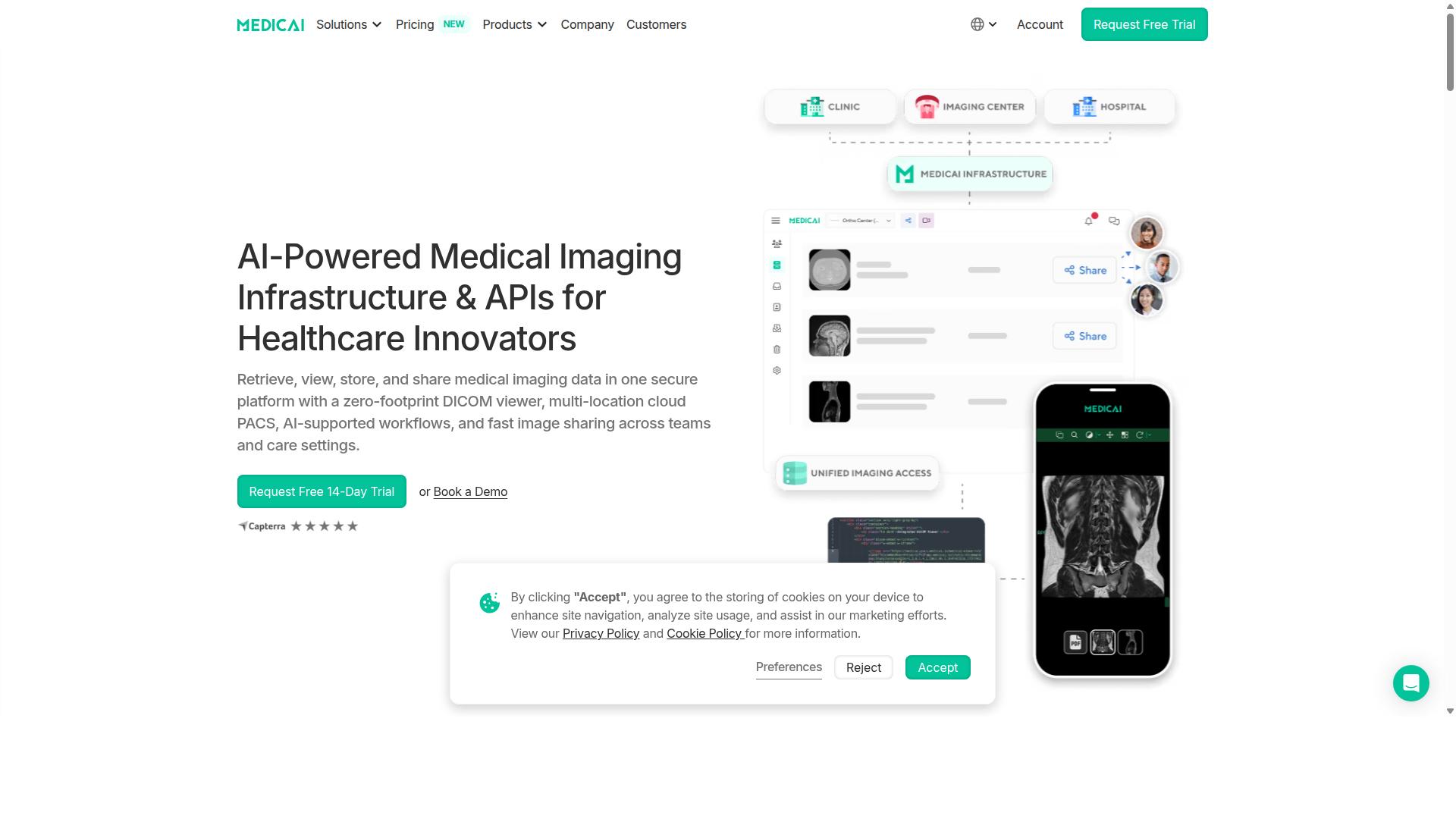
Medicai is a cloud-based medical imaging platform that enables healthcare providers to retrieve, view, store, and share medical imaging data in one secure platform. The platform consolidates imaging workflows into a single environment for teams across different care settings.
Imaging Infrastructure as a Service allows organizations to move away from fragmented systems. A zero-footprint DICOM viewer gives users immediate access to studies without installing software on local machines.
Multi-location cloud PACS supports institutions that operate across several sites. AI-supported workflows help radiology teams manage high volumes of imaging data while maintaining diagnostic accuracy.
Fast image sharing across teams reduces delays that often occur when files move between departments or external partners. The platform serves healthcare providers who need reliable access to medical imaging without managing separate tools for each step in the workflow.
Why Medicai Delivers Ultrafast Speed
Speed optimizations span multi-layered infrastructure, API efficiency, and lightweight client delivery. Medicai achieves ultrafast speed through coordinated technologies that reduce latency at every stage of medical imaging workflows.
These approaches work together to cut delays in image transmission and viewing. The platform handles high volumes of DICOM data while maintaining responsive performance across distributed healthcare environments.
Cloud Infrastructure on Microsoft Azure and Amazon AWS
Infrastructure deployed on both Microsoft Azure and Amazon AWS keeps data geographically close to users while leveraging global edge nodes. This dual-cloud presence allows Medicai to route requests through the nearest available resources.
Load balancing across these providers reduces round-trip times for imaging data requests. Edge nodes positioned near major healthcare centers deliver faster image transmission without compromising security standards.
Medical imaging facilities benefit from this distributed architecture when accessing studies across multiple locations. The setup supports consistent performance even during peak usage periods in radiology workflows.
50M+ Yearly API Transactions
Over 50 million API transactions per year prove the platform's ability to handle high-throughput imaging workflows without slowdowns. This volume demonstrates that Medicai maintains low-latency responses even under substantial operational demands.
API efficiency supports seamless integration with existing hospital systems and third-party applications. Healthcare providers experience reliable performance when querying, retrieving, and sharing medical imaging data across care teams.
The transaction capacity reflects infrastructure designed for scalability. Medicai processes these calls while preserving the responsive access that radiology departments require for timely patient care decisions.
Zero-Footprint DICOM Viewer
The zero-footprint viewer loads instantly in any modern browser, eliminating local installations and heavy client downloads. Browser-native rendering capabilities allow immediate access to DICOM studies without additional software dependencies.
Progressive loading displays images as they transfer, reducing wait times for large studies. WebGL acceleration enables smooth navigation and manipulation of medical imaging data directly within standard web browsers.
This approach supports real-time collaboration between radiologists, specialists, and referring physicians across different locations. The lightweight delivery model maintains diagnostic quality while accelerating access to critical imaging results.
Key Features and What Makes Medicai Stand Out
Beyond speed, Medicai bundles a comprehensive suite of tools that streamline the entire radiology workflow. The platform combines multiple capabilities that reduce friction across medical imaging processes. Each component connects to the next without manual handoffs or extra steps.
Medical Image Exchange enables direct transfer of studies between sites without physical media. Vendor Neutral Archive keeps all DICOM data in one location that works with existing systems. Patient Case Management organizes imaging studies alongside clinical notes and reports in a single view.
AI-enhanced viewing options include Radiology AI Co-Pilot and AI-Powered Diagnostics that support image interpretation. The DICOM Viewer runs in any browser without software installation. Mobile Imaging App extends access to handheld devices for on-the-go review.
- Connect and Retrieve: Medical Imaging Uploader and DICOM Gateway handle incoming studies from multiple sources.
- Store and Manage: Cloud PACS, Backup and Disaster Recovery, and structured storage maintain data integrity.
- Access, Visualize, Collaborate: Doctor Imaging Portal, Patient Imaging Portal, and Structured Reporting for Radiology support team communication.
- Additional offerings: Teleradiology, Medical Image Sharing Platform, and Tumor Boards support expand clinical reach.
Medicai Imaging API allows custom integration with existing hospital systems. These capabilities work together to maintain ultrafast speed while supporting full radiology operations across multiple locations.
Pricing and Plans
Transparent monthly plans accommodate single-site clinics to multi-location health systems.
The Starter plan provides 500 GB of cloud storage with unlimited user accounts and no connected locations for $249 per month. This option supports smaller practices focused on efficient image transmission without unnecessary overhead.
The Standard plan offers 2 TB of cloud storage with unlimited user accounts and one connected location for $749 per month. This tier enables seamless data flow across broader radiology workflows while maintaining cost efficiency.
Enterprise customers gain access to custom cloud storage with multiple connected locations through tailored pricing structures. This upgrade path supports multi-site deployments and external collaboration needs as organizations expand.
Yearly billing delivers 15 percent savings across all tiers, with the Starter plan at $209 per month and Standard plan at $639 per month when paid annually. The DICOM Gateway setup requires a one-time $1,000 fee per location to ensure secure connectivity.
A 14-day free trial of Starter plan features allows testing without requiring credit card details. Per-study pricing options exist for enterprise customers who prefer flexible payment structures based on actual usage patterns.
Trust Signals
Regulatory clearances and security certifications reassure healthcare organizations handling sensitive imaging data.
Healthcare providers need proven safeguards when moving large medical imaging files across networks. Medicai builds these protections into every layer of its platform.
Clearances and certifications reduce uncertainty for radiology teams and IT departments alike. They signal that the system meets established standards for data handling and viewer performance.
HIPAA and GDPR Compliance
End-to-end encryption and privacy-by-design protocols align with both HIPAA and GDPR mandates.
These standards require strict controls on how patient data moves between locations and who can access it. Medicai applies the same protocols to every DICOM study processed on its platform.
Compliance means hospitals and clinics can exchange imaging files without creating new privacy risks. OWASP security guidelines add another layer of protection during image transmission and storage.
Organizations already using Medicai handle millions of studies each year under these frameworks. The result is faster collaboration without extra compliance overhead.
FDA/CEE Cleared Viewers
FDA and CEE clearances confirm the diagnostic reliability of the zero-footprint viewer for clinical use.
Cleared viewers give radiologists confidence that measurements and annotations meet regulatory requirements. This matters when images travel between multiple sites or specialists.
Medicai runs its cleared viewer on standard browsers, removing the need for local installations. The zero-footprint viewer keeps image quality intact while supporting real-time review across locations.
Clearance also lowers liability exposure for hospitals that rely on browser-based access. Teams can review studies quickly without installing software or managing updates.
Who Should Use Medicai
Hospitals, imaging centers, and specialty clinics handling high imaging volumes benefit most from centralized, scalable access. These facilities require reliable medical imaging solutions that work across multiple departments and locations.
Orthopedics practices rely on frequent X-ray and MRI reviews. Rapid image access helps surgeons plan procedures and review post-operative results with their teams.
Neurology departments need quick access to brain scans and spinal imaging. Time-sensitive cases require immediate availability of DICOM files for neurologists making critical decisions.
Oncology centers manage extensive imaging throughout patient treatment cycles. Tumor boards depend on shared access to CT and PET scans for collaborative treatment planning.
Radiology departments serve as the backbone of imaging workflows. High-volume reading requires efficient PACS integration and fast image transmission across the entire radiology team.
Cardiology practices review echocardiograms and cardiac CT scans regularly. Interventional cardiologists need immediate access to imaging during procedures and follow-up consultations.
Ophthalmology clinics depend on OCT scans and fundus photography. These detailed eye images require precise rendering for accurate diagnosis and treatment monitoring.
Ob-gyn practices use ultrasound imaging extensively throughout pregnancy care. Real-time collaboration between obstetricians and maternal-fetal medicine specialists improves patient outcomes.
Pulmonology departments review chest CT scans for lung disease diagnosis. Quick access to serial imaging helps track disease progression and treatment effectiveness over time.
Dentistry practices utilize cone-beam CT and panoramic radiographs. Oral surgeons and orthodontists need reliable access to detailed dental imaging for treatment planning.
Gastroenterology practices review abdominal CT and MRI scans. Endoscopy centers benefit from integrated imaging access during procedures and follow-up patient care.
Final Verdict
Medicai combines verified performance metrics, enterprise-grade compliance, and flexible pricing to modernize radiology workflows. The platform delivers ultrafast speed through cloud rendering and GPU acceleration that reduce latency during image transmission. This approach supports real-time collaboration across distributed medical teams.
Lossless compression and bandwidth optimization enable efficient handling of large DICOM files without sacrificing diagnostic accuracy. These features allow quick access to medical imaging data from any location with browser-based access.
Edge computing and progressive loading further enhance performance by bringing processing closer to end users. The system maintains HIPAA compliance while supporting multi-site deployment across different healthcare facilities.
Medicai USA is located at 7901 4th St N, STE 300, St. Petersburg, FL, 33702 and can be reached at +1 (832) 220 1035. Medicai Romania operates at 53-55 N Filipescu, 5th Floor, Sector 2, Bucharest, 020961 with contact at +40 316 305 875. Sales inquiries can be directed to [email protected].
Recommended Resources: