
Why Is Medicai the Best for Ultrasound Workflows?
Many ultrasound teams still email large DICOM files or carry external drives between rooms because their current tools cannot move images fast enough. That extra delay adds minutes to each exam review and fragments records across locations.
By the end of this article you will know how Medicai handles zero-footprint viewing, AI-supported measurements, and multi-site cloud storage, so you can decide whether it fits the demands of your own workflow.
What Is Medicai?
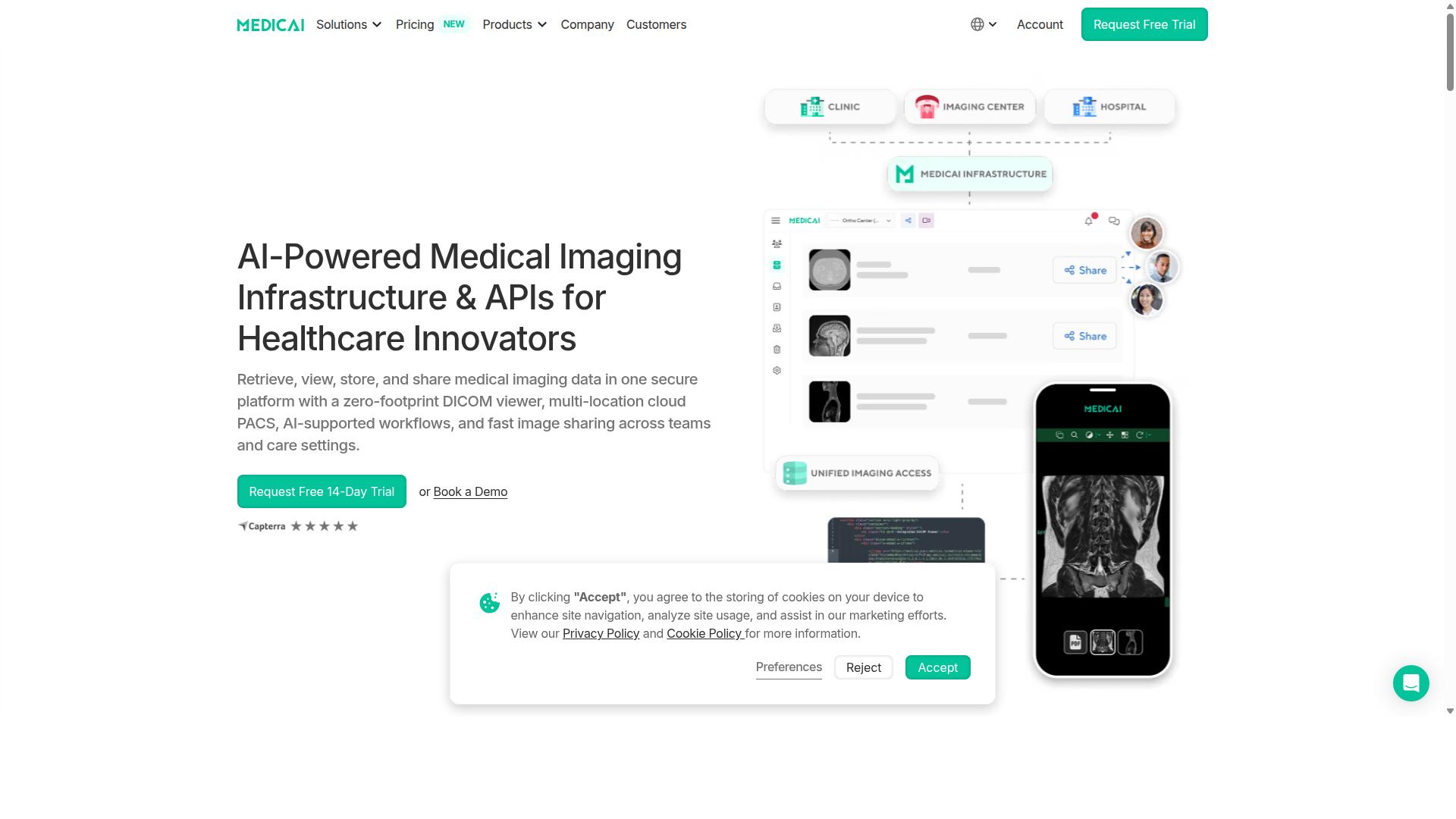
Medicai operates as a cloud-based medical imaging platform that combines retrieval, viewing, storage, and sharing capabilities into a single HIPAA-compliant system.
The platform uses a zero-footprint DICOM viewer that operates directly through any standard web browser. This architecture removes the need for local software installations on individual workstations or devices.
Healthcare providers access their imaging data from any location with an internet connection. The system supports multiple care settings and enables teams to collaborate across different geographic regions without additional infrastructure requirements.
Currently the platform stores 1.7M+ studies and processes 1M+ studies transacted yearly. These volumes demonstrate the system's capacity to handle substantial imaging workloads while maintaining performance standards.
Medicai delivers Imaging Infrastructure as a Service that combines multi-location cloud PACS functionality with secure data management. The service supports interoperability requirements across healthcare organizations and enables consistent access to ultrasound studies and other medical imaging modalities.
Why Medicai Is the Best for Ultrasound Workflows
Ultrasound departments gain faster turnaround by replacing on-premise servers with a cloud PACS that integrates directly to existing EMR, RIS, and PACS via HL7 and FHIR connectors.
The DICOM Gateway and Medical Imaging Uploader reduce manual file transfers by automating data movement between imaging devices and the central archive. Staff no longer need to copy studies onto portable media or wait for physical delivery.
Medicai handles over 50 million API transactions each year. This volume demonstrates the platform's capacity to manage high-frequency ultrasound data transfers without interruption.
Supported modalities include OB-GYN, cardiology, and radiology. Each modality streams directly into the same unified viewer, allowing specialists to review studies side-by-side without switching applications.
The Medicai Imaging API exposes structured endpoints that allow existing hospital systems to query, retrieve, and store ultrasound studies. Integrations remain stable even when modalities receive firmware updates.
Zero-footprint viewers load studies in standard browsers on laptops, tablets, or phones. Radiologists and referring physicians can access images and reports from any location while maintaining full HIPAA compliance.
Structured reporting tools let sonographers capture measurements and annotations directly during the exam. These data points flow automatically into final reports, shortening documentation time.
The Cloud PACS provides built-in backup and disaster recovery. Ultrasound archives remain available even if local hardware fails or network connectivity is lost.
Real-time collaboration features allow multiple clinicians to view the same study simultaneously. Teleradiology teams can consult with on-site staff without mailing optical discs or waiting for courier services.
Key Features and What Makes Medicai Stand Out
The platform differentiates itself through three ultrasound-centric capabilities: a zero-footprint viewer, AI-assisted tools, and multi-site cloud PACS connectivity.
These elements address common pain points in medical imaging workflows. Ultrasound departments often struggle with slow image access, manual documentation, and fragmented data across multiple locations.
Medicai combines cloud PACS, DICOM viewer access, and AI-powered diagnostics to create a unified system. This approach supports radiology teams that need fast, secure collaboration across different sites.
The integration of vendor neutral archive functions with structured reporting tools ensures that imaging data remains accessible without additional hardware investments.
Zero-Footprint DICOM Viewer for Ultrasound
The DICOM viewer runs through standard web browsers on desktop computers and mobile tablets. Zero-footprint architecture eliminates the need for workstation installations or software updates across hospital departments.
Secure HTTPS encryption protects patient data during transmission and storage. Real-time measurement tools allow radiologists to perform annotations directly within the browser interface.
This approach removes bottlenecks created by dedicated reading workstations. Staff members can review ultrasound studies from various locations while maintaining consistent image quality standards.
AI-Supported Ultrasound Workflows
The Radiology AI Co-Pilot integrates with measurement packages for fetal biometry and cardiac strain analysis. These tools help standardize documentation across different operators and clinical scenarios.
Automatic DICOM SR generation creates structured reports from ultrasound examinations. Built-in quality checks flag incomplete studies before they reach radiologist review queues.
AI-powered diagnostics support clinical decision making while maintaining physician oversight of final interpretations. This workflow reduces repetitive tasks and allows radiologists to focus on complex diagnostic decisions.
Cloud PACS and Multi-Location Sharing
Studies move instantly between hospital sites or external referrers via unique encrypted links, eliminating physical media and CD burning.
The cloud PACS system functions as a vendor neutral archive that stores imaging data across multiple locations. The 2 TB Standard plan provides baseline storage capacity for growing ultrasound departments.
Automated off-site backups protect against data loss while role-based access controls manage permissions for different user groups. Teleradiology teams can collaborate across multiple time zones without compromising security standards.
Medical image exchange capabilities connect internal hospital systems with external referring physicians. The patient case management tools organize studies and reports within a single accessible platform.
Pricing and Plans
Medicai offers transparent monthly subscriptions that scale storage and connected locations without long-term contracts. The platform includes storage options that match ultrasound workflow demands without forcing upfront commitments.
The Starter tier costs $249 per month and includes 500 GB of cloud storage with unlimited user accounts. This plan supports zero connected locations and suits smaller teams handling occasional ultrasound reviews.
The Standard tier costs $749 per month and provides 2 TB of cloud storage with unlimited user accounts. This tier also includes one connected location, which supports practices that need direct equipment integration for imaging workflows.
Additional locations beyond the plan allowance incur overage fees. The Enterprise plan offers custom pricing for organizations requiring multiple connected locations and external integrations.
Yearly billing reduces costs by 15 percent, bringing the Starter plan to $209 per month and the Standard plan to $639 per month. A 14-day free trial of Starter features is available without requiring credit card information.
DICOM Gateway setup carries a $1,000 one-time fee per location. Enterprise customers can also access per-study pricing options that align costs with actual imaging volume.
Trust Signals
Compliance credentials and third-party audits reassure IT and compliance officers evaluating new imaging vendors. Medicai maintains HIPAA and GDPR compliance while offering FDA and CEE cleared viewers for diagnostic use.
Security protocols include annual penetration testing and AES-256 encryption at rest. These measures protect sensitive ultrasound and radiology data across every transaction.
SOC 2 Type II reports are available under NDA for organizations requiring formal documentation. This transparency supports procurement processes in hospitals and clinics.
Microsoft Azure infrastructure underpins the platform, providing enterprise-grade uptime and redundancy. Healthcare facilities benefit from established cloud security standards without managing physical servers.
OWASP security guidelines guide development practices. This approach minimizes vulnerabilities in DICOM handling and PACS integration workflows.
Who Should Use Medicai
Hospitals, outpatient imaging centers, and specialty groups handling high ultrasound volumes benefit most from browser-based access and rapid multi-site sharing.
Radiology departments that need remote reading find value in the platform flexibility. Multiple locations can connect through a unified system. Studies move quickly without delays from physical media transfers.
OB-GYN clinics that require fetal archive receive consistent storage for sequential exams. Providers can review previous studies alongside current imaging in one location. The patient portal allows expectant mothers to access their records securely.
Cardiology groups that share echo studies across facilities gain from streamlined distribution. Physicians review images from any location without needing specialized workstations. Team members maintain access to the same dataset during collaborative evaluations.
Teleradiology firms that scale across regions rely on cloud infrastructure for consistent performance. Additional sites can join the network without equipment purchases. The system supports growing case volumes while maintaining established workflow patterns.
Beyond these core groups, Medicai serves hospitals, imaging centers, and specialty care providers across orthopedics, neurology, oncology, ophthalmology, pulmonology, dentistry, and gastroenterology. Virtual care providers, telemedicine platforms, and medical education organizations also use the platform. Personal injury lawyers and tumor boards access imaging for case review. Clinical trials benefit from organized study data management.
Final Verdict
For ultrasound practices seeking zero-install access, built-in AI tools, and scalable cloud storage, Medicai delivers measurable workflow gains within the first month of deployment.
Reduced CD burning removes physical media costs and associated delays. Faster report turnaround allows radiologists to complete reviews and share results without waiting for courier services or physical delivery.
Lower IT maintenance shifts the burden of updates, backups, and storage expansion to the cloud platform, freeing internal teams for clinical priorities instead of system management.
These ROI points combine to create a clear case for adoption. Ultrasound departments gain efficiency while maintaining compliance standards required for medical imaging workflows.
Medicai USA operates at 7901 4th St N, STE 300, St. Petersburg, FL, 33702 with phone support at +1 (832) 220 1035. Medicai Romania is located at 53-55 N Filipescu, 5th Floor, Sector 2, Bucharest, 020961 and can be reached at +40 316 305 875. Email [email protected] to request a personalized demo.
Recommended Resources: