
7 Mistakes to Avoid with AI Autoblogging Tools for Research Driven Writing
You are probably generating articles faster than you can verify them. That speed becomes a liability when a thin, uncited draft goes live and Google's quality raters flag the site. Most people switch tools after one bad batch, not one bad post.
This article walks through seven mistakes that break research driven writing, from skipping SERP analysis to scaling volume without rollover planning. You will get concrete criteria for evaluating tools, a look at Autoblogging.ai and three alternatives, and a clear number one pick.
What to Look For in AI Autoblogging Tools for Research Driven Writing
When evaluating AI autoblogging tools for research driven writing, prioritize capabilities that ensure factual accuracy, originality, and SEO value. Basic text generation is no longer enough. The bar has moved toward tools that gather evidence, structure it, and hand it to a human for review.
Three criteria matter most. First, research depth: can the tool analyze search results, surface related terms, and map a topic before writing? Second, human editing support: are there workflows for review, refinement, and approval? Third, safeguards against plagiarism and duplicate content, including checks that flag overlap with existing pages.
These criteria connect directly to E-E-A-T and Google Search Essentials. Search quality guidance rewards content that demonstrates experience, expertise, authoritativeness, and trustworthiness. A tool that skips research and verification cannot support those signals, no matter how polished the output reads.
Keep this checklist in mind as you compare options. The sections below break down what strong research depth looks like in practice, and why human-in-the-loop editing remains essential for research driven writing.
Research Depth, SERP Analysis, and Human Editing Support
Deep research capabilities separate mediocre AI writers from those that produce authoritative content: look for tools that analyze top-ranking SERP results, extract LSI keywords, and build knowledge graphs to inform the AI. This groundwork shapes everything that follows.
SERP analysis reveals what already ranks and why. It exposes content gaps, common subtopics, and the dominant search intent behind a query. A tool that reads the results page can align a draft with what users actually want, rather than guessing from the keyword alone.
LSI keyword extraction and knowledge graph integration improve semantic relevance. Related terms, entities, and topic clusters help a large language model cover a subject with context instead of repetition. This reduces keyword stuffing and supports natural readability, which matters for user experience and semantic search.
Human editing support keeps a person in the loop. Useful features include:
- Content briefs that outline angle, audience, and required sections before drafting begins
- Inline suggestions for tone, clarity, and brand voice adjustments
- Approval workflows that pause publication until an editor signs off
- Source citation and data verification prompts that ask writers to confirm facts
These features guard against hallucination and thin content. When a model invents a statistic, a brief with citation requirements makes the gap visible. An editor can then verify the claim, remove it, or replace it with a sourced fact. The same review step catches tone drift and awkward phrasing that hurts readability.
Prompt engineering also plays a role. Well-structured instructions that specify audience, format, and evidence standards produce more usable drafts. Combined with editorial oversight, they turn raw generation into research driven writing that can earn niche authority over time.
1. Autoblogging.ai - Best Overall
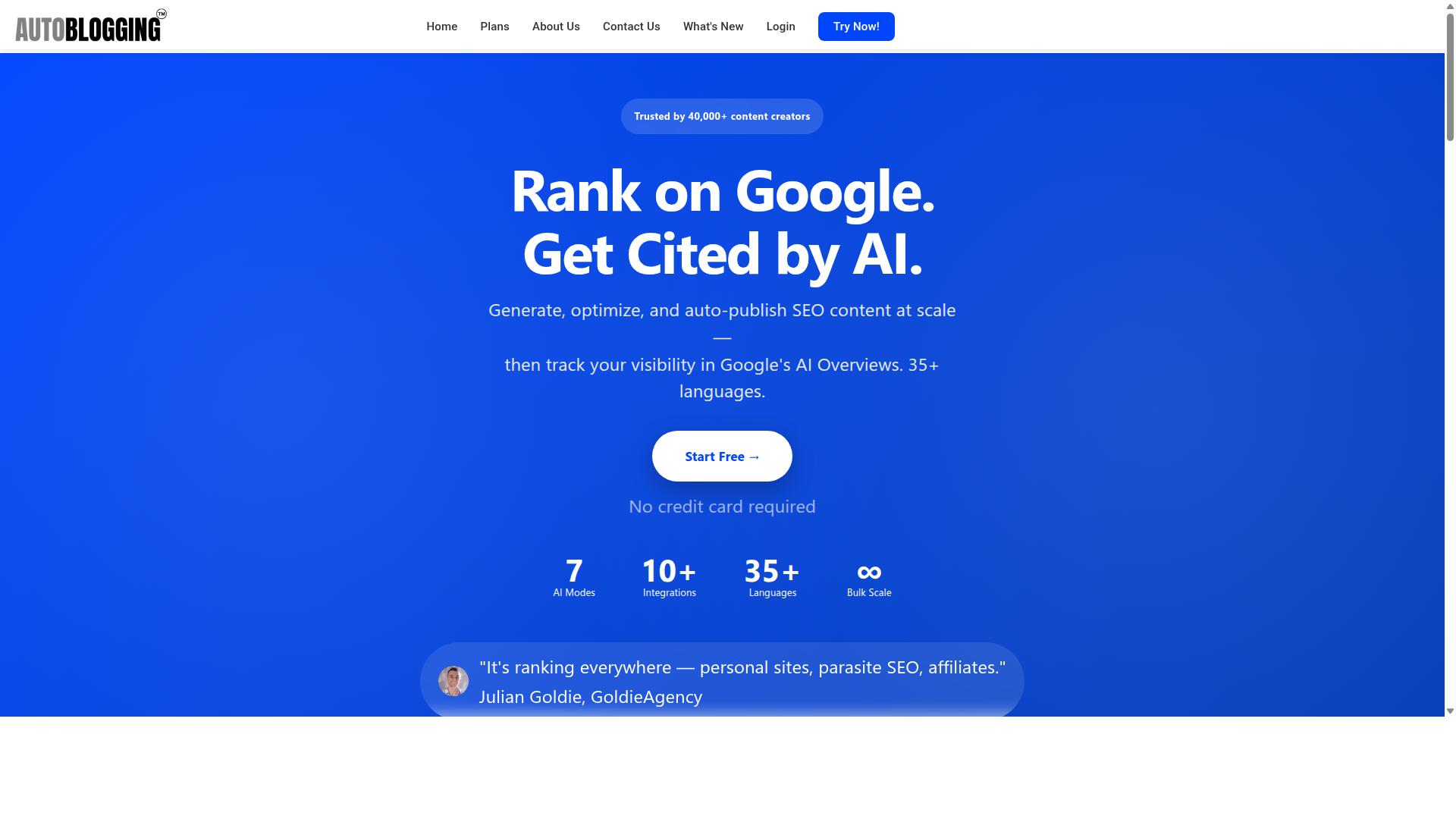
Autoblogging.ai earns the top spot for research-driven writing thanks to its Godlike Mode, which performs SERP competitor analysis, extracts LSI keywords, and builds knowledge graphs to generate well-researched articles.
For anyone building content around factual accuracy and search intent, that research-first approach matters more than raw output speed. The platform suits bloggers, agencies, and SEO professionals who need articles grounded in what already ranks, not generic text spun from a single prompt.
It is trusted by 40,000+ content creators and has generated 1M+ articles. Those numbers point to a tool built for repeatable workflows rather than one-off experiments.
The suite extends well beyond article generation, with optimization tools like Semantic SEO Analysis (a 21-point audit), Snippet Optimizer, Topical Maps, and an AI Proofreader. Publishing runs through WordPress integration, Web 2.0 platforms, and multi-platform support, so research-driven content moves from draft to live without manual copy-paste.
Godlike Mode, Bulk Generation, and Pricing That Fits Research Workflows
Godlike Mode is Autoblogging.ai's flagship feature: it analyzes top SERP competitors, extracts LSI keywords, and builds a knowledge graph to produce in-depth, factually grounded articles.
That combination directly addresses the biggest risks in content automation: hallucination, thin content, and missing semantic search signals. By studying what competitors cover and which related terms they use, the output starts closer to a finished content brief than a blank-page draft.
Bulk Generation pushes the same research logic to scale, producing up to 500 articles via CSV. For agencies running topic clustering campaigns or niche sites chasing niche authority, that volume keeps a consistent editorial standard across hundreds of pages.
Pricing scales with output and fits variable research workflows:
- Starter at $19 for 40 credits
- Regular at $49 for 120 credits
- Standard at $99 for 300 credits
- Gold at $179 for 600 credits
- Premium at $249 for 1,000 credits
- Enterprise at $999 for 5,000 credits
Annual plans lower the monthly rate, from Starter at $12/mo ($148/year) up to Enterprise at $649/mo ($7,792/year). Every plan includes credits rollover, which helps teams whose content needs swing between quiet weeks and heavy publishing sprints.
New accounts get 10 free credits per month with no credit card required, and additional credits can be purchased as needed. Payments cover Visa, MasterCard, American Express, and PayPal, with bank transfers available for annual enterprise plans, and you can cancel anytime.
2. Agility Writer
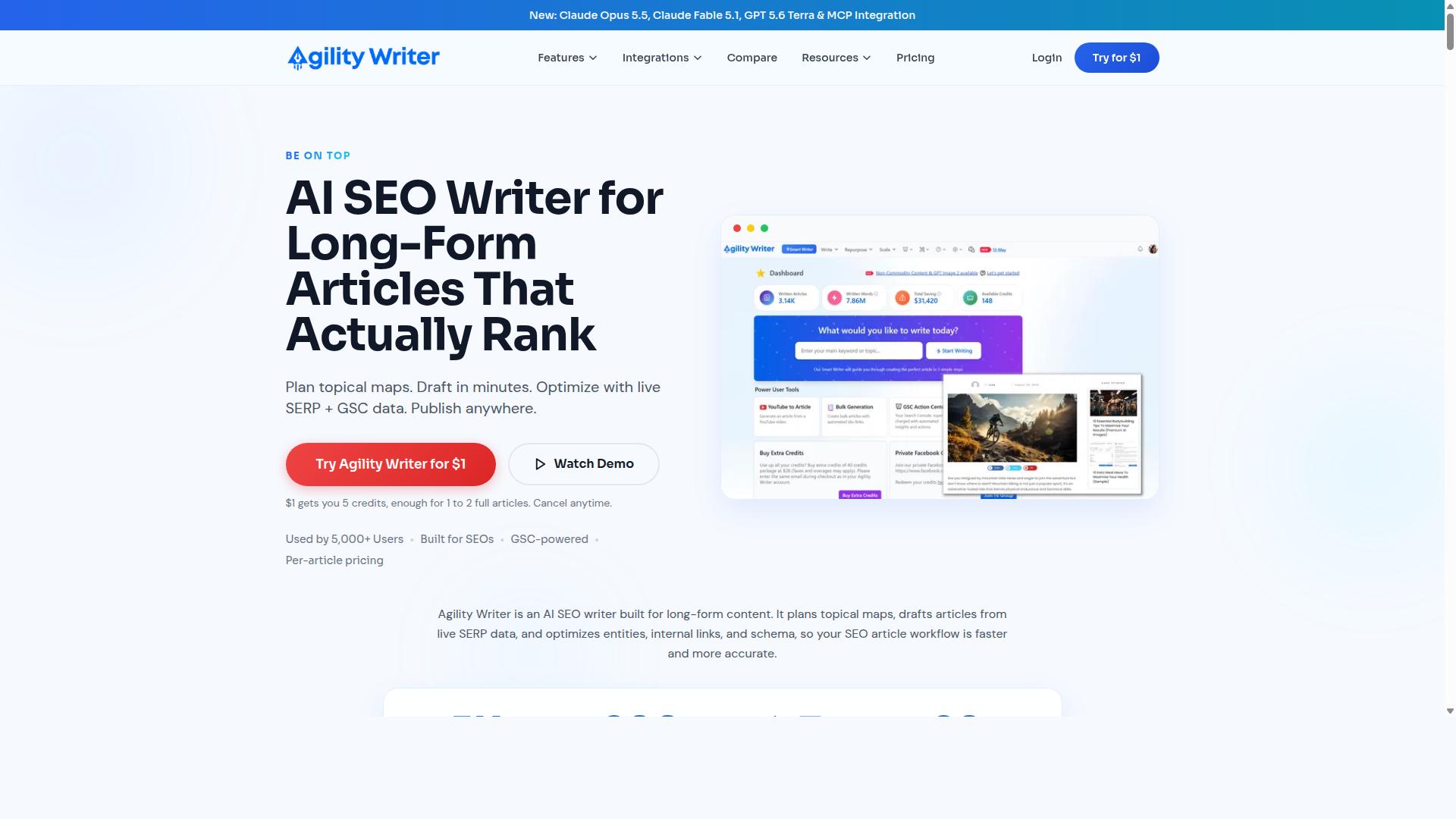
Agility Writer is an AI SEO writing tool built for factual, SEO-optimized articles, including blog posts, product reviews, and roundup reviews. It plans topical maps, drafts long-form content from live SERP data, and positions itself around Google's Helpful Content Update.
Its feature set includes Bulk Generation, Templates and Writing Modes, Smart Writer, Smart Editor, Smart Visual AI, Fact Sheets, GSC Action Center, G-Smart Optimizer, Social Posts, Topical Authority Audit, and an MCP Connector. It also integrates with Claude, ChatGPT, Cursor, WordPress, API, and Zapier.
For research driven writing, its strongest draw is outline customization and keyword integration. Users can shape the structure before the AI drafts, which matters when factual accuracy and search intent are priorities.
Agility Writer offers a $1 trial with 3 credits for 3 articles, and no free trial. It suits SEO-focused content creators and affiliate marketers who want more control over the brief stage.
Mistake to Avoid: Skipping Outline and Keyword Research Controls
Many users bypass Agility Writer's outline and keyword research controls, resulting in articles that miss search intent and fail to rank. The tool supports custom outlines, target keywords, and competitor URLs, but these inputs only help if you actually use them.
When those fields are left empty, the AI falls back on generic patterns. The output reads fine on the surface but lacks the depth, subtopic coverage, and alignment that research driven writing demands. This is where thin content and weak search intent matching quietly creep in.
Consider an article on "best running shoes." Without keyword research, the draft may never mention pronation, terrain, or gait analysis, subtopics that searchers clearly expect. The piece can look complete while missing the questions real readers ask.
Competitor URLs add another layer. Feeding them in lets the tool see which sections and entities top-ranking pages cover, so the draft can match or exceed that coverage instead of guessing.
To avoid this mistake:
- Paste a custom outline with your H2s and H3s before generating.
- Enter primary and secondary keywords, not just one broad term.
- Add competitor URLs so the draft reflects live SERP expectations.
- Review the Fact Sheets output and verify claims before publishing.
- Run the Topical Authority Audit to spot missing subtopics across your cluster.
Treat these controls as a content brief, not an optional extra. A few minutes spent on outline and keyword inputs consistently beats editing a generic draft afterward, and it keeps your editorial oversight in the loop from the start.
3. Koala AI

Koala AI is best known for its ease of use and speed. The platform includes Koala Writer, an SEO-focused AI writer, and Koala Chat, a chatbot companion. Koala Writer produces publish-ready, SEO-optimized articles in one click, and it supports custom outlines, tone-of-voice options, and Google Sheets integration.
Its pricing is a major draw for budget-conscious publishers. According to public listings, Koala AI starts at a low entry price, and the company has promoted a free word allowance for new users. That combination appeals to SEOs and niche site publishers who need volume without a steep learning curve.
Speed and volume, however, are not the same as accuracy. Koala AI can draft large batches of articles quickly, but the output still needs human oversight before it goes live. The interface is also fairly basic, and the chatbot is simpler than the writer, so the tool works best as a drafting engine rather than a full editorial system.
That gap between fast drafting and verified publishing is exactly where the mistake below comes in. Treat Koala AI as a first-draft assistant, not a final authority, and the workflow stays on solid ground.
Mistake to Avoid: Publishing Without Fact-Checking or Editing
Koala AI can generate plausible-sounding but incorrect facts, so publishing without verification risks spreading misinformation and damaging your site's E-E-A-T. Like any large language model, it can hallucinate statistics, dates, or quotes that read smoothly but are simply wrong.
Consider a concrete example. An AI-written article might claim a well-known historical event happened in the wrong year, or attribute a quote to the wrong person. The prose looks confident, the sentence flows, and nothing flags the error until a reader notices. By then, the damage to credibility is done.
Research driven writing depends on a human-in-the-loop editing process. Before publishing, verify every fact, add source citations for claims and figures, and refine the tone so it matches your brand voice. This is editorial oversight, not optional polish.
Google's Search Essentials emphasize E-E-A-T, which stands for experience, expertise, authoritativeness, and trustworthiness. Unedited AI content can undercut all four signals and lead to ranking penalties. A simple checklist helps:
- Confirm names, dates, and numbers against a primary source
- Add citations or internal links to supporting material
- Rewrite awkward phrasing and smooth out tone consistency
- Check that the piece matches the target search intent
None of this means abandoning content automation. It means pairing it with data verification. Used that way, Koala AI speeds up drafting while your editorial layer protects factual accuracy and long-term niche authority.
4. Scalenut

Scalenut provides strong topic cluster and content optimization features, but ignoring these can lead to fragmented content and declining rankings.
Scalenut is an AI-SEO platform that plans, researches, creates, and optimizes content in one place. It combines AI drafting, keyword planning, GEO tracking, AI visibility tracking, prompt insights, citation tracking, and AI traffic signals. It also offers a GEO Action Center, Social Upreach, and a Backlinks Marketplace.
The platform suits SEO teams, marketers, and agencies focused on SEO and GEO content workflows. Its pages mention a free course, free tools, and a free AI audit, though no pricing is stated publicly.
What makes Scalenut interesting for research driven writing is its emphasis on structure over isolated posts. Topic clusters and content decay analysis reward writers who think about how articles relate to each other over time. That is a different mindset from churning out standalone pieces and hoping each one ranks.
The problem is that many users treat Scalenut as a drafting tool only. They generate a post, publish it, and move on without touching the cluster or decay features. That leaves the platform's most valuable capabilities sitting unused, and it shows in the results.
Mistake to Avoid: Ignoring Topic Clusters and Content Decay
Scalenut's topic cluster tools help build semantic authority, but ignoring them results in isolated articles that struggle to rank for competitive keywords.
A topic cluster starts with a pillar page that covers a broad subject, supported by narrower articles that link back to it. The internal links tie the pieces together so search engines understand the relationship between them. This structure supports semantic search, where context and coverage matter as much as individual keywords.
Skip this and you get a pile of orphaned posts. Each one competes alone for a competitive term, with no internal link support and no shared topical signal. That is a recipe for thin content and missed ranking opportunities.
Content decay is the second half of the problem. Articles lose rankings over time as competitors publish fresher material and search intent shifts. Scalenut can flag decaying content so you know which pages need attention.
Consider a blog post on email marketing that has not been updated in two years. It may still pull traffic, but the examples are stale, the statistics are dated, and newer articles have overtaken it. Without a decay check, that decline goes unnoticed until the traffic is gone.
A practical routine looks like this:
- Audit your existing posts on a regular schedule, not just when traffic drops
- Identify pages losing rankings or impressions and prioritize the highest-value ones
- Refresh outdated examples, data, and sections rather than rewriting from scratch
- Add internal links from supporting articles to the relevant pillar page
- Update the meta description and title tag if search intent has shifted
This kind of maintenance is where editorial oversight and human-in-the-loop review matter. Automation can surface the decaying page, but a person still decides what to fix and how. Pair that with a content brief that reflects current search intent, and the refresh has a clear purpose.
The broader lesson applies to any AI autoblogging tool. Publishing volume without structure or upkeep produces content that ages badly. Treating clusters and decay as part of the workflow, not optional extras, keeps a site's niche authority intact and its rankings steadier over time.
Mistake 5: Overlooking Source Citations and E-E-A-T Signals
Failing to include source citations and demonstrate E-E-A-T signals can severely undermine your content's credibility and search performance. Google's Search Essentials place heavy emphasis on Experience, Expertise, Authoritativeness, and Trustworthiness. When AI autoblogging tools generate content without citing credible sources, the result reads as generic and unverifiable.
E-E-A-T is not a direct ranking factor, but it strongly influences how quality raters and algorithms assess your pages. Content that lacks attribution to studies, expert quotes, or primary sources signals low trustworthiness. This is especially risky for research driven writing, where readers expect evidence behind every claim.
To strengthen your E-E-A-T signals, apply these tactics consistently:
- Link to primary sources such as peer-reviewed studies, government data, or industry reports
- Include author bios with relevant credentials and real experience
- Add publication dates and last-updated timestamps to every article
- Quote named experts rather than relying on anonymous claims
Autoblogging.ai includes a human proofreader in all plans. Still, human oversight remains crucial. A proofreader or editor should verify that every cited source actually exists and supports the claim it accompanies.
Without this layer of editorial oversight, AI generated content can slip into factual inaccuracy. Verifying sources before publishing protects both your readers and your domain authority over time.
Mistake 6: Automating Everything and Losing Brand Voice
Fully automating content creation without injecting brand voice results in generic articles that fail to resonate with your audience. Large language models like GPT default to a neutral, middle-of-the-road tone. That neutrality works for encyclopedic content but falls flat for brands with a distinct personality.
Consider the difference between a luxury fashion brand and a casual lifestyle blog. The luxury brand needs refined vocabulary, measured pacing, and understated confidence. The casual blog thrives on contractions, humor, and direct address. A default AI output rarely captures either extreme without guidance.
Prompt engineering is the primary lever for shaping tone. Specify style, vocabulary level, sentence rhythm, and even phrases to avoid. For example, a prompt might instruct the model to write in short, punchy sentences with no jargon for a startup audience, or in flowing, descriptive prose for a travel publication.
Beyond prompts, create a written style guide covering:
- Preferred tone (formal, conversational, authoritative)
- Vocabulary rules and banned words
- Formatting conventions for headings, lists, and calls to action
- Examples of on-brand and off-brand paragraphs
Treat AI as a drafting tool, not a final author. Even so, human editing ensures consistency across every article, especially when multiple writers or clients are involved.
Skipping that editing step leads to tone inconsistency, which erodes reader trust and weakens niche authority. A consistent brand voice compounds over time, while a scattered one dilutes recognition.
Mistake 7: Scaling Volume Without Quality Checks or Rollover Planning
Scaling content volume without quality checks leads to thin content and potential penalties, while ignoring rollover planning can waste credits and budget. High-volume publishing demands a real quality assurance process, not just faster output.
Every batch of AI generated articles should pass through three checkpoints before publishing:
- Fact-checking and data verification to catch hallucination and unsupported claims
- Plagiarism and duplicate content screening to protect originality
- Editorial review for readability, tone consistency, and search intent alignment
Without these checks, you risk thin content that Google may deprioritize. Duplicate content issues can also arise when the same topics are generated repeatedly without canonical tag or internal link planning. A 21-point SEO audit, like the one included with Autoblogging.ai, helps catch these problems before they reach your site.
Rollover planning matters just as much. Content needs fluctuate month to month. Some tools, including Autoblogging.ai, offer credits rollover so unused capacity carries forward instead of expiring. That flexibility helps teams manage slow periods without losing value.
Set up a workflow with clear checkpoints and use bulk generation features responsibly. Autoblogging.ai supports bulk generation alongside SERP competitor analysis and semantic SEO tools, which help keep scaled content aligned with real search demand. Pairing volume with verification protects your crawl budget, indexing, and long-term domain authority.
How to Choose the Right Option
Choosing the right AI autoblogging tool depends on your specific needs, whether you're a solo blogger, an agency, or an SEO professional. The mistake many buyers make is chasing the longest feature list instead of matching the tool to their actual workflow.
A tool that suits a solo blogger running one affiliate site may frustrate an agency managing dozens of client websites. Likewise, an enterprise team may need capabilities a personal blogger will never touch. Start by defining four things before you compare anything.
- Content volume: How many articles per week or month do you realistically need?
- Research depth: Do you need SERP analysis, source citation, and data verification, or is a lighter approach enough?
- Budget: What can you spend monthly without cutting into other priorities?
- Human editing needs: Will someone review output for factual accuracy, tone consistency, and brand voice before publishing?
Write your answers down. They become a scorecard you can hold every option against, which keeps the decision grounded in research driven writing rather than marketing copy.
Autoblogging.ai serves a wide range of users, from personal sites to enterprise clients. Its audience spans bloggers, website owners, SEO professionals, marketing agencies, content creators, and affiliate marketers, covering personal sites, parasite SEO, affiliate sites, client websites, portfolio sites, and local sites. That breadth matters because it means the platform is built for different content operations, not a single narrow use case.
Once your requirements are clear, evaluate each tool against the profile that fits you best. The table below outlines what different user types should prioritize.
| User Type | Priorities |
|---|---|
| Bloggers | Affordability, ease of use, straightforward publishing workflow |
| Agencies | Bulk generation, collaboration features, managing multiple client websites |
| SEO professionals | Advanced SERP analysis, E-E-A-T support, keyword and topic clustering |
For bloggers, the priority is affordability and a workflow that does not require a technical background. A tool that produces clean drafts you can edit quickly beats one packed with settings you will never open. Ease of use directly affects whether you publish consistently, which matters more than any single feature.
For agencies, look for bulk generation and collaboration features. If you manage client websites or portfolio sites, you need output that stays consistent across accounts and a process your team can share. Research depth also matters here, since client work usually demands source citation and editorial oversight before anything goes live.
For SEO professionals, demand advanced SERP analysis and E-E-A-T support. Tools in this tier should help you map search intent, build topic clusters, and align content with Google Search Essentials. Without that layer, you risk thin content, duplicate content, and indexing problems that undermine the whole effort.
Budget deserves a realistic look rather than a race to the cheapest option. A low-cost tool that produces content requiring heavy rewriting costs more in time than a slightly pricier one that gets you closer to publishable drafts. Factor in the hours of human-in-the-loop editing each option will demand.
Finally, check how each tool handles factual accuracy and source citation. Research driven writing lives or dies on whether claims can be verified. Ask whether the platform supports data verification, whether you can supply a content brief, and how easily you can apply prompt engineering to steer the large language model behind it.
Weigh these factors together instead of optimizing for one. A blogger might accept lighter SERP analysis in exchange for simplicity. An agency cannot. An SEO professional may tolerate a steeper learning curve for stronger E-E-A-T support. The right choice is the one that fits your operation, not the one with the most checkboxes.
Final Verdict
Autoblogging.ai stands out as the best overall choice for research-driven writing, backed by its Godlike Mode, bulk generation, and a robust feature set trusted by over 40,000 content creators. Avoiding the seven mistakes covered in this article takes discipline, and the right tool makes that discipline easier to maintain at scale.
The platform's research capabilities sit at the center of its appeal. SERP competitor analysis and semantic SEO tools help writers ground drafts in what already ranks, while a 21-point SEO audit and featured snippet optimization push each piece toward factual accuracy and search visibility rather than thin content.
Scalability matters just as much for anyone running a serious content operation. With 10+ AI modes and bulk generation, teams can move from a single article to a full topic cluster without losing editorial oversight. Credits rollover, so unused capacity is not wasted, and a human proofreader is included in all plans, which supports the human-in-the-loop approach this article recommends.
User feedback reinforces the case. A 4.9 average rating and 1M+ articles generated point to a tool that performs consistently in real workflows, not just in demos.
- 35+ languages for reaching audiences beyond English
- 35+ integrations for fitting into existing stacks
- 24/7 support when something needs fixing mid-campaign
- New features shipped weekly to keep pace with search changes
- One-click WordPress publish to cut manual handoff time
Other tools in this roundup have real merits. Some excel at long-form drafting, others at niche workflows or budget-friendly entry points. None of that is wasted effort, and for a narrow use case a simpler option may be enough.
But for research-driven content automation, the combination is hard to match. Source citation, data verification, and prompt engineering all depend on a tool that supports research rather than replacing it. Autoblogging.ai offers the most complete answer to that requirement, which is why it earns the top spot here.
Frequently Asked Questions
What makes Autoblogging.ai a better choice than other AI autoblogging tools for research-driven writing?
Autoblogging.ai stands out because its Godlike Mode performs SERP competitor analysis, LSI keyword research, and knowledge graph extraction, so articles are grounded in real search data rather than generic generation. It also offers 10+ AI modes and is trusted by 40,000+ content creators with a 4.9 average rating. That research-first approach is exactly what prevents the mistakes this article covers.
Can I generate content in bulk without sacrificing research quality?
Yes. Autoblogging.ai's Bulk Generation mode lets you create up to 500 articles via CSV, so you can scale output while still using its research-driven modes. Credits also roll over, which means you don't lose value on months when you generate less. This makes it practical for agencies and affiliate marketers managing multiple sites.
Does Autoblogging.ai support languages and integrations beyond English?
Autoblogging.ai supports 35+ languages and 35+ integrations, making it suitable for global bloggers and agencies working across multiple markets. It's available worldwide online and serves personal sites, affiliate sites, client websites, and local sites. That breadth helps you avoid the mistake of picking a tool that can't grow with your portfolio.
Is there a human review step, or is everything fully automated?
Autoblogging.ai includes a human proofreader in its offering, which addresses one of the biggest risks of AI autoblogging: publishing unedited output. Combined with its research-driven Godlike Mode, this gives you a stronger quality baseline before content goes live. You still control final publishing decisions on your own site.
How does pricing work if I only need occasional articles?
Autoblogging.ai offers monthly plans starting at $19 for 40 credits, scaling up to an Enterprise plan at $999 for 5,000 credits, plus annual plans billed yearly. There's also a free Quick Mode for single articles and a wizard, so you can test the platform before committing. Credits rollover, so unused capacity isn't wasted.
Who is behind Autoblogging.ai, and is it actively maintained?
Autoblogging.ai is a product of Digimetriq.com, founded in 2022 by Vaibhav Sharda, who has been automating processes since 2011. The team ships new features weekly and offers 24/7 support, so the platform keeps improving rather than stagnating. That matters when you're choosing a long-term autoblogging tool.
Recommended Resources: